



Here’s something that keeps most business owners up at night: the average company loses about
$5,600 per minute of unplanned downtime. Now multiply that by an entire day, or worse, a week, during a botched office relocation, and you’re looking at a financial nightmare.
Your business doesn’t stop just because you’re moving. Clients still need responses. Vendors still need invoices. Your team still has deadlines. But here’s the thing… most office moves in Northern New Jersey turn into multi-day disruptions because companies wing it or hire the cheapest commercial moving company NJ has to offer without asking the right questions.
I know, you were thinking you’d just move over a weekend and be back to business Monday morning. But unless you’ve got a solid plan (and the right business movers New Jersey can trust), that fantasy usually ends with scattered IT equipment, confused employees, and angry clients who can’t reach you.
After helping 250+ businesses relocate across Berkeley Heights and Northern New Jersey over our 100+ years in operation, we’ve seen what works and what absolutely tanks. Let’s walk through the five steps that’ll keep your business humming while you transition to your new space.
Step 1: Plan Early and Coordinate All the Moving Parts
Here’s where most businesses mess up: they start planning three weeks before the move. Do yourself a favor and give yourself 3-6 months of lead time, especially if you’re relocating a mid-sized office or dealing with specialized equipment.
Early planning isn’t just about booking office relocation services in NJ: it’s about coordinating everything that makes move day actually work. You need to lock down specific dates with your current building manager, your new landlord, and your moving company. And I mean specific: down to the hour you can access loading docks and elevators.
 Think about it: if your building only allows freight elevator access between 6 AM and 9 AM, and your movers show up at 10 AM, you’re already behind schedule. Those delays cascade fast.
Contact the facility managers at both locations to schedule any renovations, network cabling, or furniture installation that needs to happen before your team shows up with boxes. Nothing kills momentum like discovering the new conference room isn’t wired for your video conferencing setup on move-in day.
At Liberty Transportation and Storage (learn more in our About Us section), we coordinate these logistics with you during our commercial moving consultation because we’ve learned that the details matter—a lot.
Step 2: Create a Detailed Inventory and Floor Plan
You know what causes the most chaos on moving day? Nobody knows where anything goes in the new office. Your movers end up playing musical chairs with desks while your team stands around watching the clock tick.
Start by documenting everything that’s moving. And I mean everything: from the CEO’s desk to the break room microwave. Ask each department head to create an inventory of their area’s furniture and equipment. This serves two purposes: you’ll know exactly what you’re moving (and what you’re ditching), and you’ll have a reference if anything goes missing.
Now here’s the game-changer: create an accurate floor plan of your new space showing exactly where each piece goes. Use CAD software if you’ve got it, or at minimum, a detailed sketch with measurements. Label everything: which desk goes by which window, where the server rack sits, and which conference room gets the fancy chairs.
This isn’t busywork. This is what separates a one-day move from a week-long disaster. When your movers know exactly where to place each item, they’re not interrupting you every five minutes asking questions. Your team can start working immediately instead of spending days rearranging furniture. And if you’re coordinating household moves alongside the office transition (it happens more than you’d think), leaning on experienced residential movers in New Jersey can keep everything aligned.
Pro tip: Prioritize which functions absolutely must be operational immediately. Maybe accounting can handle a bit of chaos for a day, but your customer service team needs phones and computers running ASAP. Build your floor plan around keeping critical operations up first.
Step 3: Update Your Business Information Everywhere
 This step seems obvious, but you’d be shocked how many businesses forget to update their address until clients start complaining about returned mail. Start updating your information at least 3-4 weeks before the move, not the day after.
Hit the big ones first:
- Your website and Google My Business listing (crucial for local SEO)
- Business cards and marketing materials
- Email signatures for all employees
- Vendor accounts and service providers
- Bank accounts and financial institutions
- Your accountant, insurance company, and legal counsel
Don’t forget the post office: file a change of address for your business mail. But here’s what a lot of people miss: update your digital presence everywhere your business shows up online. That means directory listings, industry associations, Better Business Bureau, and anywhere else customers might look for you.
For businesses in Berkeley Heights and surrounding areas, maintaining accurate local listings is critical. You don’t want potential clients finding outdated information when they search for “moving company Berkeley Heights NJ” or similar services in your industry.
Have your team update their email signatures the week before the move. It’s a small touch that keeps clients informed and prevents confusion when they’re trying to send you something.
Step 4: Prepare Your IT Systems and Brief Your Team
Let’s talk about the elephant in the room: your IT infrastructure. Servers, computers, phone systems, and network equipment: this stuff can’t just get tossed in a box with your staplers.
Before anything gets unplugged, back up everything. And I mean everything. Cloud backups, external hard drives, and, yes, even some hard copies of critical documents. You should never put your entire business in any stranger’s hands: even professional movers: without a backup plan.
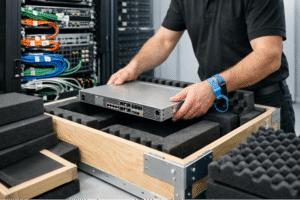
 Create a detailed plan for disconnecting and reconnecting your IT systems. If you’ve got servers, specialized software, or complex phone systems, coordinate with your IT team and your commercial moving company in NJ to ensure proper handling. At Liberty Transportation, we’ve got specialized equipment and training for handling sensitive electronics because we know one wrong move can cost you thousands in damaged equipment and lost data. If you also need a safe place to stage furniture, files, or overflow equipment during the transition, our storage and moving solutions help you keep operations flexible without turning your new office into a warehouse.
Here’s where employee communication becomes critical. Your team needs clear instructions about:
- What they should pack themselves (personal items, desk contents)
- What the movers will handle (furniture, equipment)
- When they should pack (timeline leading up to move day)
- Where they’ll be working during the transition
- What to bring on moving day versus what to leave at home
Send out written instructions. Don’t rely on a single all-hands meeting where half the team zones out. Send emails, post signs, and create a shared document: over-communicate like your business depends on it (because it does).
Assign moving coordinators for each department. These folks become the point people who ensure their teams are prepared and know where to be on moving day. This delegation keeps things organized and prevents you from becoming the bottleneck answering everyone’s questions.
Step 5: Execute Move Day with On-Site Management
Move day isn’t the time to catch up on emails from Starbucks. You need someone on-site managing the operation: preferably someone who knows your business and can make quick decisions.
Your on-site project manager should:
- Direct the movers and answer questions
- Troubleshoot problems as they arise
- Coordinate timing between old and new locations
- Ensure critical systems get set up first
- Conduct final walkthroughs of both buildings
Prioritize setting up essential work areas first. Maybe that means getting IT infrastructure running before you arrange the lobby furniture. Or setting up customer service workstations before you unpack the executive offices. Whatever keeps revenue flowing and customers happy gets priority.
This is where working with experienced business movers New Jersey companies trust makes a massive difference. We’ve coordinated hundreds of commercial moves, so our team knows how to keep things moving efficiently while protecting your equipment and minimizing business downtime.
Confirm all logistics 24-48 hours before the move. Call the building managers, double-check elevator reservations, and verify your movers are on schedule. Do a final walkthrough of your current office to catch anything that might’ve been missed.
After the move, don’t just abandon the old space. Do a thorough final walkthrough to ensure nothing’s left behind and you’re meeting all lease obligations. You don’t want to lose your security deposit over a forgotten file cabinet.
 Your Office Move Doesn’t Have to Mean Lost Business
Look, office relocation in NJ doesn’t have to be the disaster story everyone warns you about. With proper planning, detailed coordination, and the right commercial moving partner, you can relocate your entire operation without losing a single day of productivity.
The difference between a smooth transition and a chaotic nightmare comes down to preparation and expertise. Following this office move checklist will put you miles ahead of businesses that try to DIY their relocations or hire movers based solely on price.
Frequently Asked Questions
How long does an office move typically take?
Most small to mid-sized office relocations in Northern New Jersey take 1-2 days of actual moving time, but the entire process from planning to full operation should be allocated 3-6 months. The actual duration depends on your office size, amount of equipment, and whether you’re moving within Berkeley Heights or relocating across state lines. A well-coordinated move with professional office relocation services in NJ can often be executed over a weekend, with employees returning to full productivity Monday morning.
How much does a commercial office move cost in New Jersey?
Commercial moving costs vary widely based on your office size, distance, specialized equipment needs, and timing. Most business movers in New Jersey provide binding estimates after an on-site assessment. Expect to budget anywhere from $1,500 for a small office to $15,000+ for larger operations with extensive IT infrastructure. The key is getting a detailed, binding estimate that won’t surprise you with hidden fees on moving day.
How do professional movers handle servers and sensitive electronics?
Reputable commercial moving companies use specialized equipment and training for IT infrastructure. This includes climate-controlled trucks, anti-static packaging, custom crating for servers, and careful labeling systems. The movers should coordinate with your IT team for proper shutdown and startup procedures. At Liberty Transportation, we’ve moved everything from medical equipment to server farms, and we treat your technology with the care it deserves.
Ready to Move Your Business Without the Chaos?
We’ve been helping New Jersey businesses relocate smoothly for over 100 years: and we’ve got the testimonials to prove it (see more customer stories in our Testimonials). Our modern fleet, professional equipment, and experienced team mean your office relocation gets handled with the same care we give our Residential Movers New Jersey clients.
Request a commercial moving consultation today, and let’s discuss your specific needs. We’ll walk through your timeline, assess your equipment, and create a customized plan that keeps your business running.
Want to get started on your own? Download our complete office move checklist and begin planning your seamless transition today.